-
real danger or risk acceptable?
(Last updated October 2006)
live in a society where technology has become a substantial part important part of modern life. The use of technology is generating a wide range of electromagnetic fields, ranging from very high frequency, such as radio and television antennas, radar, microwaves, cell phones, even the very low frequency, as the high- tension, computer screens, grids, etc.
Much of our daily activity often occurs in areas where electrical appliances and plentiful, all the time remaining under the influence of countless radiation of magnetic fields.
Over the past thirty years, the electromagnetic density of the environment has increased, generating a new kind of pollution, intangible and immaterial, which some authors have termed "electromagnetic pollution."
These electromagnetic radiations are divided two types: ionizing radiation (IR) and the Non-Ionizing Radiation (NIR)
Ionizing Radiation, to put it in a simple way that everyone can understand, are those that are capable of starting electrons atoms that cross, even those who are human cells. In this category are harmful X-rays and gamma rays, the dangerous nuclear reactors, the devastating atomic bombs, etc.., Whose harmful effects are well known.
Non-Ionizing Radiation are those that do not have that ability to ionize matter, as in the previous case, and are included in this category, infrared and microwave radiation from telecommunications in general.
Although in recent decades there have been numerous studies and research worldwide, the effects caused by Non-Ionizing Radiation (NIR) are still in the field of scientific discussion, in which some denounce risks and effects on humans and other contradict definitely still left in doubt what is the real dimension of the phenomenon and the true extent of the effects of this radiation in human being.
The accumulation of these emissions creates a phenomenon that has been called "electro". Some researchers say that above a certain threshold and by that cumulative effect of radiation can trigger autoimmune diseases, allergies, chronic fatigue, anemia, nervous system disorders and even cancers. Countless effects that have never been shown with scientific rigor that require such statements.
This issue of the impact of electromagnetic fields on human health has been tried in recent times, in different forums, both private and governmental, in a way that we believe is at less reckless, creating a psychosis in the population, before the widespread ignorance, "just in case" speak out against the installation of anything that might resemble an antenna.
is not denying or hindering the development and progress of technology, as many claim, we will improve the quality of life of people.
Improving the quality of life in our modern society, just is through the expansion and economic progress and development of related technologies and communications in general.
This requires that we learn to live with the technology, accepting new challenges while trying to minimize the risks that can generate its implementation.
There are two types of risks, some that may be acceptable and others that can not be accepted in any way. The latter are those that produce harm to human or ecological balance of the planet.
All human activity involves a potential risk. The use of electromagnetic systems that generate non-ionizing radiation, also involves a risk of course, which has never known, and undoubtedly, if they have not been able to demonstrate its allegedly harmful effects or its traceability, is framed within acceptable risk , and has no point of comparison, the harmful effects of ionizing radiation, yes you can see, and are well known throughout society.
The balance point surely is to determine what kind and amount of risk we are willing to take, and what is the cost of not accepting them.
For example: the alleged risk of non-ionizing radiation, are you willing to live without cell phones? Could do without listening to the radio? And without the TV?
And if we were much more severe: Does anyone want to live without electricity in the world?
you know that the sun is the most important source of energy in our planet, and thus one of the most important RNI generators?, and nobody would think so, try to avoid its effect on mankind, for example, roofing cities.
The truth is that electromagnetic pollution began to be concern not only the authorities but has also created concern among the workers who are professionally exposed to it and the general public, and the issue has installed between us, and is currently under debate in our society.
is good then that we express our opinions publicly, in one way or another and we pay special attention to the referrals that this issue may have for our business.
For now questioning are getting stronger cellular systems, although as we said, nothing is proven, but "just in case" policy and legislative authorities, speak out against the proliferation of these systems.
But the center of the debate are the cell phone companies, taking the brunt, we should not be left alone, but on the contrary, we should be expectant. In this case the question is how much longer will happen, until some haggard looking for personal or political returns, come by the radio stations? We must be very warned for when this happens, and the first step is to be well informed.
Regulatory
The World Health Organization (WHO - World Health Organization) has been expressed regarding this issue, establishing occupational exposure limits for workers and the limit for the general public which are accepted internationally and provide some reassurance to those who are so concerned about the issue.
In our country, in 1995, the maximum magnitudes of exposure to non-ionizing radiation for RF systems between 100 kHz and 300 MHz have been defined by the Ministry of Health and Social Action, through Resolution No. 202 MSyAS/95.
Subsequently, dated December 29, 2000, was issued Resolution No. 530/2000, the Ministry of Communications, which provides for the mandatory application of the National Safety Standard in all telecommunications systems that radiate in the frequency range indicated.
The preamble of this Resolution of the Ministry of Communication, where he goes to that experienced in the U.S., you can read "... that the Federal Communications Commission's (FCC) has no harmful effect , under certain values \u200b\u200bof rate of energy absorption ... "
To be fair, we should add that no harmful effects have been demonstrated above those values.
The decision of the Ministry of Communications referred to Volumes I and II Survey of environmental non-ionizing electromagnetic radiation, which can be found in the Technical Information Center of the CNC and the Ministry of Health and Social Ministry of Health, which can not be attached as annexes to the resolution, given its huge volume.
Later in the year 2002 through Resolution No. 269 CNC/2002, then amended in 2003, by Resolution No. 117 CNC/2003, the Commission National Communications (TNC) has established the general framework for the control of non-ionizing radiation that cause the activity of radio stations. Finally
following the questions received, in 2004, the CMC promulgated a new rule that supersedes the previous two, and establishes protocols for risk assessment of RF stations, which is Resolution No. 3690 CNC/2004 and is currently in force.
For its part, the Ministry of Labour, Employment and Social Security in 2003 also approved technical specifications of radiation in the workplace, as detailed in Annex II of Resolution No. MTESS/2003 295.
The levels of exposure to NIR established by the Ministry of Health and Social Action and endorsed by the Ministry of Communications, are listed in the table below:
(Last updated October 2006)
live in a society where technology has become a substantial part important part of modern life. The use of technology is generating a wide range of electromagnetic fields, ranging from very high frequency, such as radio and television antennas, radar, microwaves, cell phones, even the very low frequency, as the high- tension, computer screens, grids, etc.
Much of our daily activity often occurs in areas where electrical appliances and plentiful, all the time remaining under the influence of countless radiation of magnetic fields.
Over the past thirty years, the electromagnetic density of the environment has increased, generating a new kind of pollution, intangible and immaterial, which some authors have termed "electromagnetic pollution."
These electromagnetic radiations are divided two types: ionizing radiation (IR) and the Non-Ionizing Radiation (NIR)
Ionizing Radiation, to put it in a simple way that everyone can understand, are those that are capable of starting electrons atoms that cross, even those who are human cells. In this category are harmful X-rays and gamma rays, the dangerous nuclear reactors, the devastating atomic bombs, etc.., Whose harmful effects are well known.
Non-Ionizing Radiation are those that do not have that ability to ionize matter, as in the previous case, and are included in this category, infrared and microwave radiation from telecommunications in general.
Although in recent decades there have been numerous studies and research worldwide, the effects caused by Non-Ionizing Radiation (NIR) are still in the field of scientific discussion, in which some denounce risks and effects on humans and other contradict definitely still left in doubt what is the real dimension of the phenomenon and the true extent of the effects of this radiation in human being.
The accumulation of these emissions creates a phenomenon that has been called "electro". Some researchers say that above a certain threshold and by that cumulative effect of radiation can trigger autoimmune diseases, allergies, chronic fatigue, anemia, nervous system disorders and even cancers. Countless effects that have never been shown with scientific rigor that require such statements.
This issue of the impact of electromagnetic fields on human health has been tried in recent times, in different forums, both private and governmental, in a way that we believe is at less reckless, creating a psychosis in the population, before the widespread ignorance, "just in case" speak out against the installation of anything that might resemble an antenna.
is not denying or hindering the development and progress of technology, as many claim, we will improve the quality of life of people.
Improving the quality of life in our modern society, just is through the expansion and economic progress and development of related technologies and communications in general.
This requires that we learn to live with the technology, accepting new challenges while trying to minimize the risks that can generate its implementation.
There are two types of risks, some that may be acceptable and others that can not be accepted in any way. The latter are those that produce harm to human or ecological balance of the planet.
All human activity involves a potential risk. The use of electromagnetic systems that generate non-ionizing radiation, also involves a risk of course, which has never known, and undoubtedly, if they have not been able to demonstrate its allegedly harmful effects or its traceability, is framed within acceptable risk , and has no point of comparison, the harmful effects of ionizing radiation, yes you can see, and are well known throughout society.
The balance point surely is to determine what kind and amount of risk we are willing to take, and what is the cost of not accepting them.
For example: the alleged risk of non-ionizing radiation, are you willing to live without cell phones? Could do without listening to the radio? And without the TV?
And if we were much more severe: Does anyone want to live without electricity in the world?
you know that the sun is the most important source of energy in our planet, and thus one of the most important RNI generators?, and nobody would think so, try to avoid its effect on mankind, for example, roofing cities.
The truth is that electromagnetic pollution began to be concern not only the authorities but has also created concern among the workers who are professionally exposed to it and the general public, and the issue has installed between us, and is currently under debate in our society.
is good then that we express our opinions publicly, in one way or another and we pay special attention to the referrals that this issue may have for our business.
For now questioning are getting stronger cellular systems, although as we said, nothing is proven, but "just in case" policy and legislative authorities, speak out against the proliferation of these systems.
But the center of the debate are the cell phone companies, taking the brunt, we should not be left alone, but on the contrary, we should be expectant. In this case the question is how much longer will happen, until some haggard looking for personal or political returns, come by the radio stations? We must be very warned for when this happens, and the first step is to be well informed.
Regulatory
The World Health Organization (WHO - World Health Organization) has been expressed regarding this issue, establishing occupational exposure limits for workers and the limit for the general public which are accepted internationally and provide some reassurance to those who are so concerned about the issue.
In our country, in 1995, the maximum magnitudes of exposure to non-ionizing radiation for RF systems between 100 kHz and 300 MHz have been defined by the Ministry of Health and Social Action, through Resolution No. 202 MSyAS/95.
Subsequently, dated December 29, 2000, was issued Resolution No. 530/2000, the Ministry of Communications, which provides for the mandatory application of the National Safety Standard in all telecommunications systems that radiate in the frequency range indicated.
The preamble of this Resolution of the Ministry of Communication, where he goes to that experienced in the U.S., you can read "... that the Federal Communications Commission's (FCC) has no harmful effect , under certain values \u200b\u200bof rate of energy absorption ... "
To be fair, we should add that no harmful effects have been demonstrated above those values.
The decision of the Ministry of Communications referred to Volumes I and II Survey of environmental non-ionizing electromagnetic radiation, which can be found in the Technical Information Center of the CNC and the Ministry of Health and Social Ministry of Health, which can not be attached as annexes to the resolution, given its huge volume.
Later in the year 2002 through Resolution No. 269 CNC/2002, then amended in 2003, by Resolution No. 117 CNC/2003, the Commission National Communications (TNC) has established the general framework for the control of non-ionizing radiation that cause the activity of radio stations. Finally
following the questions received, in 2004, the CMC promulgated a new rule that supersedes the previous two, and establishes protocols for risk assessment of RF stations, which is Resolution No. 3690 CNC/2004 and is currently in force.
For its part, the Ministry of Labour, Employment and Social Security in 2003 also approved technical specifications of radiation in the workplace, as detailed in Annex II of Resolution No. MTESS/2003 295.
The levels of exposure to NIR established by the Ministry of Health and Social Action and endorsed by the Ministry of Communications, are listed in the table below:
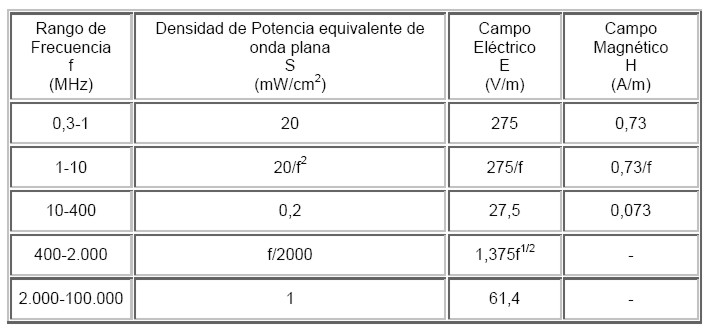
The criterion to exposed persons for work (occupational exposure) took as a period of 40 hours or in some cases brief periods of high exposures, and 50 weeks per year and must be clearly informed about the potential risks associated with their occupations. Occupational exposure limits apply to total body exposure and are a function of frequency.
These occupational exposure limits represent approximately the power density of a plane wave incident needed to produce a SAR (energy absorbed per kg) Average Length of 0.4 w / kg.
the general population, which is obviously much greater than occupational people, you may be other risks and usually can not be controlled individually. In these cases the exposure levels that are set are significantly lower than the occupational taking as parameter a fifth of them. Unlike the Occupational Exposure, Public Exposure represents the power density of a plane wave incident needed to produce the SAR averaged for total body mass of 0.08 w / kg.
COMFER
More recently passed Resolution No. 1596/2006 which states that licensees and approved for installation, operation and services for radio and television licensees to broadcast additional services whose holdings amount using the spectrum license holders and precarious and temporary registered in the Registry Decree No. 1357/89 shall comply with Resolution No. 36/0/2004 CNC.
What should broadcasting stations?
All stations are required to perform the evaluation of NIR emission according to the protocol set out in Resolution No. 3690 CNC/2004, and from that resolution No. 1596/2006 COMFER, no one can take the inattentive, even those who own the much talked about PPP.
assessment can be done in two ways: first, by the calculation based on the prediction methods, taking into account the technical parameters and the physical conditions of the station, and in the latter case by direct measurement the parameter with the proper equipment.
In both cases, the rule states protocols to be met, and for this they need to be performed by a licensed professional engineer and Certificate of Commendation issued by the professional work COPITEC (Professional Council of Telecommunications Engineering, Electronics and Computing) or the Provincial Schools with agreements reciprocity with it.
The engineer who performed the evaluation, either by calculation or by measuring predictive, should produce a report according to certain guidelines which are also specified in the standard, and that along with a copy of the Certificate of assignment, should be in power broadcaster, to be displayed in the event that CNC inspect the transmitter.
is not necessary to make any submission to the CNC. The report should only be preserved and presented at the request of the Agency.
Other Regional Standards
broadcasters should watch at their places of location of their antennas, as some agencies at the provincial level and in many cases to municipal, have issued regulations covering the topic at hand, and in many cases are stricter than national standards.
For example in the area of \u200b\u200bthe Province of Buenos Aires SPA Resolution 900/05 establishes the obligation of making the measurements and submit to the Secretariat of Environmental Policy checking them, and other environmental impact studies described in the resolution.
Similarly the Government of the Autonomous City of Buenos Aires, promulgated Resolution No. 244/GCABA/SMAYDS/01, which also establishes guidelines for measuring NIR and requires the submission of an affidavit.
final recommendation
Broadcasters Association Privadas Argentinas (ARPA) through its Technical Committee, recommends to all its broadcast partners, to comply strictly with the provisions of existing national standards, and explore between standards that may be related to the topic in their area of \u200b\u200blocation, of both a provincial and municipal levels, and implement them.
This will avoid possible sanctions for non-compliance, and otherwise ensure legal cover potential claims against entities or persons who consider themselves affected.
For workers employed on a permanent or temporary in high power transmission plant, although we have already mentioned that there is no risk to human health, taking into account that the effects are cumulative, it would be desirable, not strictly necessary, do not stay long in those places close to towers transmission, satellite boxes, masts directors, and other places where high values \u200b\u200bare checked Electric Field, minimizing the exposure time.
agree with the spirit of current regulations and recommendations issued by the Ministry of Labour, in the sense that "workers should not be unnecessarily exposed to higher levels of RF radiation near the limit values \u200b\u200bwhen they can be prevented by measures Simple. " Following this reasoning
Resolution No. 295/2003 of the Ministry of Labour, says: "All radiation exposures must be kept as low as reasonably possible [As Low As Reasonably Achievable (ALARA)], taking into account the economic and social factors. "
Another practice that we recommend, is to delineate areas that may exceed the limits of maximum exposure through a security fence, properly marked with signs to report the presence of RNI and the recommendation not to remain in those sectors.
Regarding how to address the procedure for either method of evaluation, beyond the recommendations that the engineer be hired to carry out the same, ARPA Technical Committee offers a series of general guidelines that can help to take a decision:
When should implement the predictive calculation method is not necessary to measure?
For very low power stations that are in areas not densely populated or where there is no permanent housing nearby, and do not have the transmission plant operating staff permanently. FM Stations
low power but are within the populated urban area, have their antennas mounted on towers over 30 meters high and there are no tall buildings that face less than 100 meters away from the tower.
When is
recommended to make a measurement?
AM Stations High power, especially those with operational staff within the broadcasting facility permanently.
FM Stations of medium to high, and whose antennas are mounted on towers less than 30 meters high, or that are installed on terraces of buildings or nearby buildings that are capable of receiving direct radiation from the antenna.
stations have their antennas on shared sites with other broadcasters, or other radio services, forming what the rules state as "multisite" even in cases that are outside of cities, as in the case of sites on hills or high ground near populated areas.
reiterate that these are only general recommendations, which serve as general guidance, and that broadcasters must follow the instructions of their engineers.
Prof. Eduardo Daniel Esarey
The rules mentioned in this paper can be found at the site of the National Communications Commission: Http://www.cnc.gov.ar/espectro/radiacionesNoIonizantes.asp or the Legislative Information Center of Ministry of Economy, InfoLeg in: http://infoleg.mecon.gov.ar /
More information on the site of the WHO (World Health Organization): http://www.who.int/es/
RELATED RESOLUTIONS:
Organizations National Jurisdiction
Resolution No. 202 MSY AS/95
06/06/1995 Approval of the National Safety Standard for exposure to radio frequencies between 100 kHz and 300 GHz
Resolution No. 530
Resolution No. 530
SC/2000 12/20/2000
National Security Standard mandatory for all telecommunications systems radiate certain frequencies.
CNC/2002 Resolution No. 269 18/03/1902
CNC/2002 Resolution No. 269 18/03/1902
Evaluation prior to the installation of satellite stations in accordance with the parameters of Resolution Issue 202/95. Apruébanse the Protocol to the Non-Ionizing Radiation Measurement and forms for reporting the results of these measurements.
CNC/2003 Resolution No. 117 24/01/2003
CNC/2003 Resolution No. 117 24/01/2003
Issue amend Resolution 269/2002, with the aim of establishing an extension to the obligation to measure or justify exceptions in accordance with prescribed by that standard, in conjunction with existing facilities.
MTESS/2003 Resolution No. 295 11/10/2003
Apruébanse specs on ergonomics and manual lifting load, and radiation in their workplaces.
CNC/2004 Resolution No. 3690 11/08/2004
MTESS/2003 Resolution No. 295 11/10/2003
Apruébanse specs on ergonomics and manual lifting load, and radiation in their workplaces.
CNC/2004 Resolution No. 3690 11/08/2004
Provides that the authorization holders and radio stations broadcasting station licensees must demonstrate that the radiation generated by the antennas of their stations do not affect the population in the space surrounding them. Protocol for the evaluation of non-ionizing radiation.
COMFER/2006 Resolution No. 1596 09/08/2006
COMFER/2006 Resolution No. 1596 09/08/2006
Provides that licensees and approved for the installation, operation and operation of radio broadcasting and television licensees to broadcast additional services whose holdings amount to use radio spectrum license holders and precarious and temporary registered in the Registry Decree No. 1357/89, shall comply with Resolution CNC No. 36/0/2004.
GOVERNMENT OF THE PROVINCE OF BUENOS AIRES
Environmental Policy Secretariat
Background and related Resolutions:
Article 28 of the Constitution of the Province of Buenos Aires
Establishes the right of the inhabitants of the Province, to enjoy a healthy and duty to preserve and protect it. Provision
No. 5 / 01
07/03/2001
Creation of the Environmental Risk Associated with Non-Ionizing Electromagnetic Radiation.
Resolution 900/05 20/04/2005
SPA adopts NIR exposure limits of MSyAS 202/95 and establishes an obligation to measure and present findings of the seasons.
GOVERNMENT OF THE AUTONOMOUS CITY OF BUENOS AIRES
Ministry of the Environment and Sustainable Development Resolution
No. 244 / GCABA / SMAYDS / 01
26/07/2001
Sets Guidelines for Non-Ionizing Radiation measurement. Sets deadline for submission of the affidavit of the measurement to be made according to the protocol that integrates as ANNEX I hereto.
Copyright © 2005 by Eduardo Esarey
Published and edited by the author
The opinions expressed herein are those of the author and are not given or shared by companies, associations or entities mentioned in the same .
All rights reserved. The contents of this document is protected by Intellectual Property law, therefore it is expressly prohibits any form of reproduction, distribution, public communication and transformation of this work without the express permission of the author.
The infringement of these rights may constitute an offense against intellectual property referred to in the Penal Code. Authorization
special citations:
this work or parts thereof, can be cited in papers, essays and theses for students or mid-level researchers, college, university or graduate, they pursue their studies in public institutions or private, regardless of country of origin or residence, provided they are referenced correctly, with a footnote on any page or a bibliography at the end of the work, and it is communicated to the author and is assume the commitment to submit to it, a copy of the complete work once it has been completed and delivered or published. If the quotes were verbatim, will be added in quotes.
To cite this work:
Esarey, Eduardo D., ionizing radiation, real danger or risk acceptable? in http://radiotekno.blogspot.com/ (Buenos Aires, 2005)
To contact the author:
eesarte@gmail.com
-


0 comments:
Post a Comment